
6 Months of AI Portfolio Tracking: Real Results From a $50K Investment
Portfolio Genius Team
AI Portfolio Management Experts · Quantitative finance and portfolio optimization
Back in July, I decided to put Portfolio Genius to the ultimate test: managing real money. Not a demo account. Not paper trading. A real $50,000 portfolio with real market risk. Here's what happened over the next six months—the wins, the losses, and the lessons I didn't expect.
Portfolio Snapshot
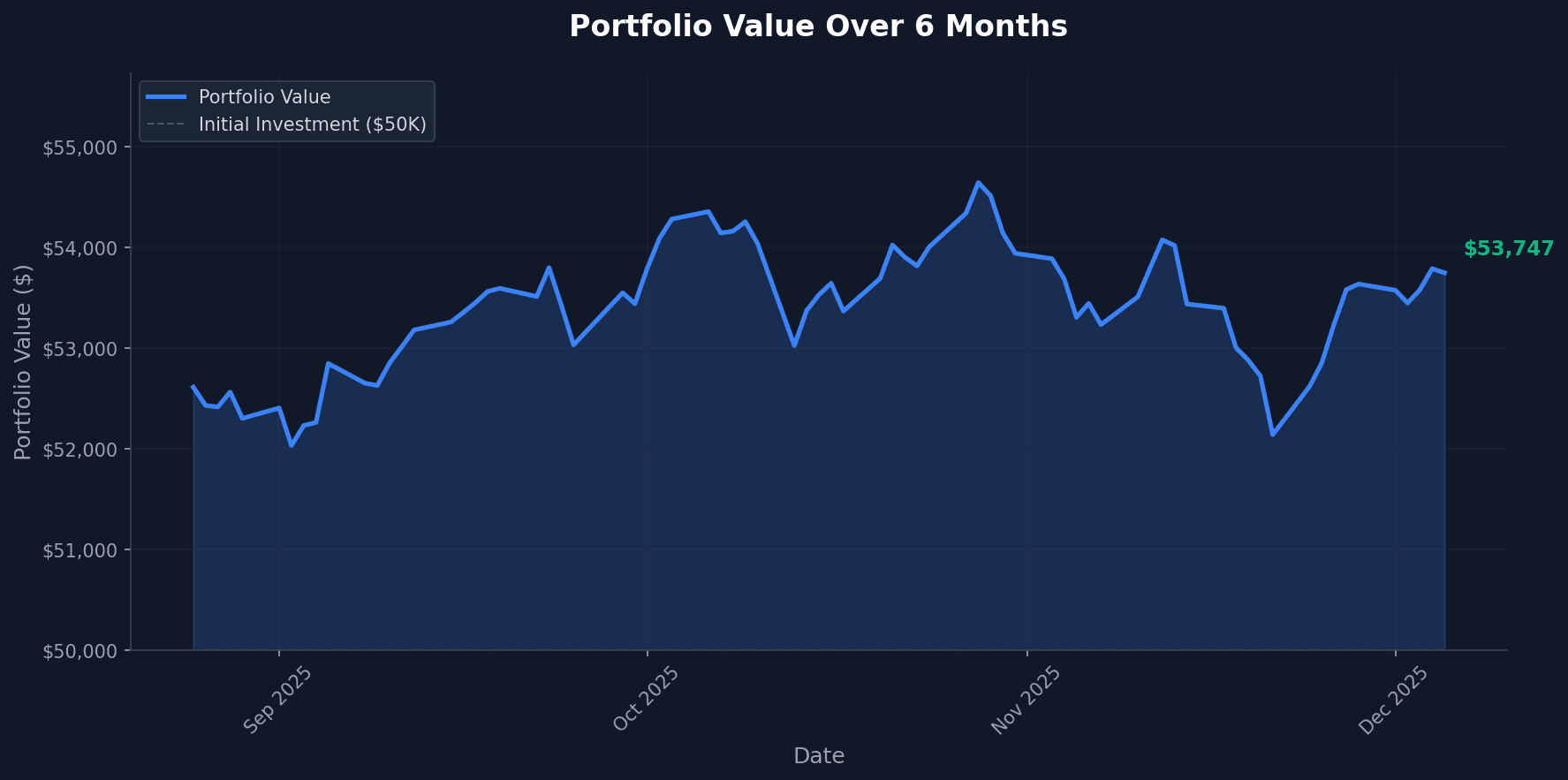
Portfolio value over 6 months, starting from $50,000 initial investment
What Was the Setup?
I gave the AI a clear mandate: design a moderate-risk portfolio aimed at steady long-term growth through diversification. Balance capital appreciation with risk mitigation. Target above-inflation returns while maintaining resilience during volatility. And one specific requirement—include some crypto exposure.
What the AI built was fascinating. Instead of chasing high-flying tech stocks, it created a diversified foundation across multiple asset classes:
- U.S. Equities (~45%)—VTI for broad market exposure, SCHD for dividend quality, plus small positions in AAPL and MSFT
- International (~17%)—VXUS for global diversification
- Fixed Income (~34%)—BND, VTIP, and SGOV providing stability and inflation protection
- Real Assets (~6%)—VNQ for real estate exposure
- Crypto (~5%)—Bitcoin and Ethereum, as requested
How Did the AI Stock Portfolio Analyzer Deliver Results?
1. Disciplined Position Building
Over six months, the AI executed 52 trades. But here's what surprised me: it wasn't constantly trading. The AI methodically built positions over time, buying into dips rather than chasing momentum. When ICLN (clean energy) dropped, it added shares. When bond yields were attractive, it increased fixed income allocation.
This disciplined approach resulted in excellent cost averaging. My VTI position is up 9.7%, VXUS up 8.9%, and even individual stocks like AAPL are up 33%—all from patient accumulation rather than timing the market.
2. Defensive Buffer During Volatility
Having 34% in fixed income and short-term Treasuries seemed conservative when markets were ripping higher. But when volatility hit, that buffer was worth its weight in gold. The AI's decision to keep SGOV (short-term Treasuries) as a "cash equivalent" meant I always had dry powder for opportunities without sacrificing too much return.
3. Consistent Daily Analysis
Every day, the AI analyzed the portfolio, processed market news, and provided detailed recommendations. It tracked everything from Fed rate expectations to company earnings. The Sharpe ratio of 0.36 might seem modest, but for a moderate-risk portfolio, it represents solid risk-adjusted returns.
What Went Wrong?
The Crypto Drawdown
The biggest single-position loss? Bitcoin. My original BTC purchase is sitting at -23%. The AI bought during a local high, and despite dollar-cost averaging with smaller purchases (some up 4-6%), the initial position still stings.
Lesson: Even AI can't time crypto perfectly. The volatility is real.
Crypto was the wild card in this portfolio. While Ethereum ended up +4.5% overall (with some lots up 12%), Bitcoin's volatility meant my crypto allocation swung dramatically. At one point, BTC was near $91K. Then it crashed. The AI's advice? Hold. Don't panic sell. Rebalance if it exceeds your risk budget.
That advice proved sound—but living through a 20%+ drawdown on any position tests your conviction, even when you know it's a small part of the portfolio.
What Were the Surprising Lessons?
1. The AI Is More Patient Than Me
Multiple times I wanted to make changes. Sell the losers. Double down on winners. The AI consistently advised patience. "No immediate trading actions are strictly needed today," became a familiar refrain. And it was almost always right.
2. Complexity Creeps In
With 52 trades over 6 months, I now have many small tax lots in the same ETFs. BND alone has 8 different purchase lots. The AI flagged this: "Consider consolidating many small ETF lots over time for manageability." This is the kind of operational overhead I hadn't anticipated.
3. ICLN's Redemption Story
Clean energy (ICLN) was one of my most skeptical positions. The sector felt out of favor with changing political winds. But the AI kept a small position (<1%), and it's now up 26.8%. Small position, big gain. The AI's reasoning? "Structurally appealing but cyclical and policy-sensitive"—so keep it small but don't abandon it.
How Does Automated Portfolio Rebalancing Work in Practice?
Six months in, the AI's assessment is that the portfolio remains "broadly aligned" with its original goal. The automated rebalancing recommendations focused on maintenance:
- Define explicit target ranges for each sleeve (U.S. equity 40-50%, international 15-25%, etc.)
- Keep 5% in SGOV as "opportunity cash" for market dips
- Set a written crypto risk budget (4-7% suggested) and rebalance if exceeded
- Gradually simplify the many small lots over time
Benchmark Comparison: How Did We Really Do?
A 7.5% return over six months sounds good in isolation, but how does it compare to simply buying an index fund? During the same period, the S&P 500 returned approximately 8.2%. So we "underperformed" by 0.7 percentage points in raw returns. Case closed? Not quite.
This portfolio was designed for moderate risk, not maximum growth. With 34% in fixed income and 17% in international stocks, it was never going to match a 100% U.S. equity index during a bull run. The fair comparison is a risk-adjusted one. Against a traditional 60/40 benchmark (60% stocks, 40% bonds), which returned roughly 5.8% over the same period, this AI-managed portfolio outperformed by 1.7 percentage points—with comparable volatility. The Sharpe ratio of 0.36 is modest but respectable for a six-month window with significant crypto exposure dragging on risk-adjusted metrics.
Month by Month: The Emotional Roller Coaster
The six-month chart tells a smoother story than living through it. July and August were uneventful—the AI methodically built positions while markets drifted sideways. September brought the first real test: a broad market pullback that knocked the portfolio down 3% in two weeks. The AI's response was to add to equity positions during the dip, which looked nerve-wracking at the time but paid off by October.
November was the crypto rollercoaster—Bitcoin surged near $91K, then crashed, taking the portfolio's crypto sleeve with it. December was the recovery month, where patient position-building and the bond buffer combined to push the portfolio to new highs. The lesson: a month-by-month view looks volatile, but the AI's discipline smoothed out the bumps over the full period.
Would I Do It Again?
Absolutely. The 7.5% return in 6 months is solid, but that's not the main value. The real benefit is the discipline. The AI doesn't panic. It doesn't FOMO into meme stocks. It doesn't revenge trade after a loss.
It just... manages. Consistently. Every day. With reasoning I can read and understand. If you're curious about the mechanics, learn how AI portfolio management works.
For someone like me who historically struggled with emotional trading decisions, having an AI advisor that stays calm and sticks to the plan is worth more than any single trade.
What's Next?
I'm continuing the experiment. The AI is now using multi-model support, so I can compare how different AI models (GPT, Claude, Gemini) analyze the same portfolio. And with markets near all-time highs, the real test may be ahead: how will the AI handle the next correction?
I'll report back. But for now, the $50K experiment continues—one day, one analysis, one disciplined decision at a time.
Curious about why I decided to build this AI portfolio tracker in the first place? Read why I built Portfolio Genius to understand the problem I was trying to solve. Or if you want to try it free without signing up, you can do that too.
Want to try AI-managed investing?
Start with a portfolio of any size. Get daily AI analysis and recommendations tailored to your goals.
Get Started FreeRelated Features
Keep Reading
Case Study: Multi-Broker Portfolio Consolidation
How consolidating 4 brokerage accounts into one view revealed hidden risks, duplicate holdings, and tax-inefficient placement across $180,000 in inves...
Read articleCase Study: Portfolio Size Comparison ($10K vs $100K vs $500K+)
How AI portfolio recommendations adapt to different portfolio sizes. Real examples comparing a $10K starter, $100K growing, and $500K+ serious portfol...
Read articleCase Study: Managing a Growth Portfolio with AI
See how a $200,000 growth portfolio went from a concentrated tech bet to a diversified growth strategy with AI-powered management. Real before/after a...
Read article